
Secrets
The few consistent stories hold that Grandpa, carrying the name William Elmer Brown, was born in Palestine, Illinois, on November 3, 1889. Grandma Brown, who claimed the maiden name of Thompson, always maintained that she was born in Pleasantville, Iowa. According to family talk, they met on a farm in North Dakota and were married in Langdon, the seat of Cavalier county, around 1912.
But that’s where the information ended. No parent names. No siblings identified. No glimpses of life prior to Aunt Genevieve’s birth in La Crosse in 1917.
At one point, I’d sent for Grandpa’s and Grandma’s Social Security number application forms, as I understood that they required applicants to list the names of their parents. When photocopies of the old forms arrived in the mail, my heart leaped when I saw that they did in fact include names. Grandma indicated her mother’s as being Frances Richards, and her father’s name as John Thompson. Grandpa listed George La Verne Brown and Mary Ellen Stine as his parents. These were the names I’d all but given up on discovering!
Yet by 2017, more than a decade and a half later, I had nothing new to add. I could not find these people. For years, I attributed my bad luck to the relative commonality of two of the surnames: Brown and Thompson. You don’t know how often I wished that our last name, passed down from father to son for centuries, had been something out-of-the-box like Schmeckpeper or Wollstonecraft.
By this time, I’d also taken DNA swabs from my cheek and sent them out for testing. I admit I was mainly interested in the genetic angle because of our Brown surname, which is so unexceptional—especially with an earliest reported ancestor with the first name, George. As you might imagine, the universe of George Browns in mid-nineteenth century America is unfathomably vast.
But even with the exactitude of science, nothing was panning out in my search for Grandpa’s and Grandma’s origins. And with each new dead-end, my long-held gloom over the prospect of being a sort of genealogical orphan (at least as far as your line went) only deepened.
Still, I used what I had and worked every angle I could think of to find something. In desperate moments, I took to speculating, going on scraps of information I’d heard over the years and trying the ideas out to see if they even seemed like they might hold together.
I remembered a story you once told me about a conversation you’d had with Genevieve. She was lamenting how she was unable to locate marriage records for Grandma and Grandpa in the North Dakota county where they claimed to have wedded. It was then you suggested half-seriously that maybe they’d never gotten married. Genevieve remarked that something like that never would have happened.
“Why the hell not?” you responded. “And what difference would it make if they hadn’t?”
During the 1990s, I drew inspiration from that conversation to write a short story, which I titled, “The Secret.” The chronology and geography were different, but it was the theme of mysterious origins that I was going for rather than any biographical accuracy.
It’s not a very well-constructed tale, I now realize. And after many submissions to journals and magazines over the years I also suspect it is unpublishable. But the story’s value to me today lies not in its literary merit, but rather its unintentional prescience.
“The Secret” is set in a hospital room, where the elderly male protagonist, Bill, is in the late stages of an unidentified terminal illness. His spouse, Marge, is with him. Their adult children have come back from their own homes far away to see him and have now left again, and Marge is in the throes of some unspoken worry. She knows the end is near for Bill, and so does he. Finally, Bill pries out of Marge the source of her concern: namely, that she wants to come clean to the kids about their secret.” Though I never explicitly reveal it in the story, my hope was the reader would discern that Bill and Marge had never bothered to formally marry. They’d met during the dust-bowl Thirties, when Bill, an itinerant “Okie,” arrived looking for work at the California orange farm that Marge’s family owned. Marge was young and innocent. She fell hard for Bill, who was slightly older, and the two consummated their infatuation one spring night in the darkness of the orange groves. Soon after, Marge abruptly left the farm with Bill after a fight with her mother, never to return or to see her family again.
After all these years, Marge, now a mother and grandmother herself, does not regret the outcome of her decision overall, but castigates herself over certain elements of her whirlwind departure, chief among them the fact that she can no longer picture her own mother.
“How shameful,” she thinks at one point. “I should at least be able to remember her face.”
To be honest, I hadn’t thought much about this fictional piece I’d written back in the nineties, but in late 2017 I discovered I had reason to revisit the story, and to marvel on the ways that art (and I use the term loosely here) can imitate life.
***
Recently, genetic genealogy has embraced the use of autosomal DNA, which allows researchers to cast a far wider net than was previously possible. No longer do the tests reveal only strictly defined, straight-line connections passed down the generations from father to son or mother to child. Now, people can examine and gauge the strength of matches with second, third, fourth cousins, and beyond: people whose most recent common ancestor might have lived as far back as several hundred years ago.
In 2017, two things happened that changed everything. Just before Thanksgiving, I discovered that my first cousin had also taken a DNA test with Ancestry.com and that we were a solid match. Now, for the first time, we could use the powerful search capabilities of this site to triangulate toward matches that we shared in common, using the paper trails of others—that is, the posted family trees of fellow subscribers—to find similarities of relation across the universe of names and localities.
One of our shared matches was a man a man named James Morrison. Our match with the man denoted a strong second-cousin relation, meaning that we shared a great-grandparent somewhere at that level of the family tree. When I contacted James late in 2017, I admitted that I knew of no Morrisons on our side, and I gave him the only surnames that I did have, those that Grandma and Grandpa provided on their Social Security number applications: Brown, Stine, Thompson, and Richards.
James Morrisoon soon responded that he had a great-grandmother by the name of Frances Richards, born in Indiana in 1857. Initially, I was stirred by the fact that the first and last name matched perfectly with the one that Grandma had listed as being her mother’s. But, as I read on, my heart sank when he added that this particular Frances had married not some chap named John Thompson, as I’d hoped to hear, but rather Angus MacKay Morrison, a Scot of highland derivation who was born in Prince Edward Island, Canada, in 1850. And their union lasted until their deaths in Montana during the early twentieth century.
Disheartened, but still hopeful that some side-relative of my newly-discovered second-cousin might also have carried the name Frances Richards, I accepted his offer to send me his paperwork.
I didn’t have to look far into it. One of the children of Angus Morrison and Frances Richards, a daughter listed as Frances Mae, had the exact same birth date as Grandma Brown: 22 June. What is more, she was born in the very location that Grandma always maintained as being her own birthplace.
These similarities were tantalizing enough, but then James Morrison informed me that, of all the children, Frances Mae is the ancestor they knew the least about, since she had disappeared early on and was never heard from again.
In December 1909, at the age of nineteen, Frances Mae Morrison had married a man named David Henderson, who was six years her senior. The 1910 Federal census of Cavalier County, North Dakota, shows them living together as newlyweds, along with Henderson’s mother and a younger brother. According to my informant, sometime later that year, Henderson joined Angus Morrison and his sons in a trek to Montana to establish new homesteads for them all. Shortly after they departed, Mae, who had stayed behind for the time being, ran off with another man.
An unfortunate consequence of Frances Mae’s decision to leave her brief and apparently unsatisfactory marriage is that she also severed ties with her family of origin. Among the surviving children noted in the 1920 obituary for Angus MacKay Morrison (which I accessed later) was his daughter, “Mae,” whose whereabouts were listed as unknown.
The genetic trail seemed foolproof. I was undeniably second cousins with James Morrison, whose father was an older brother to Frances Mae. But I am an academic historian, both at heart and by way of training, so I am always most comfortable with a hunch when it’s backed by supporting evidence.
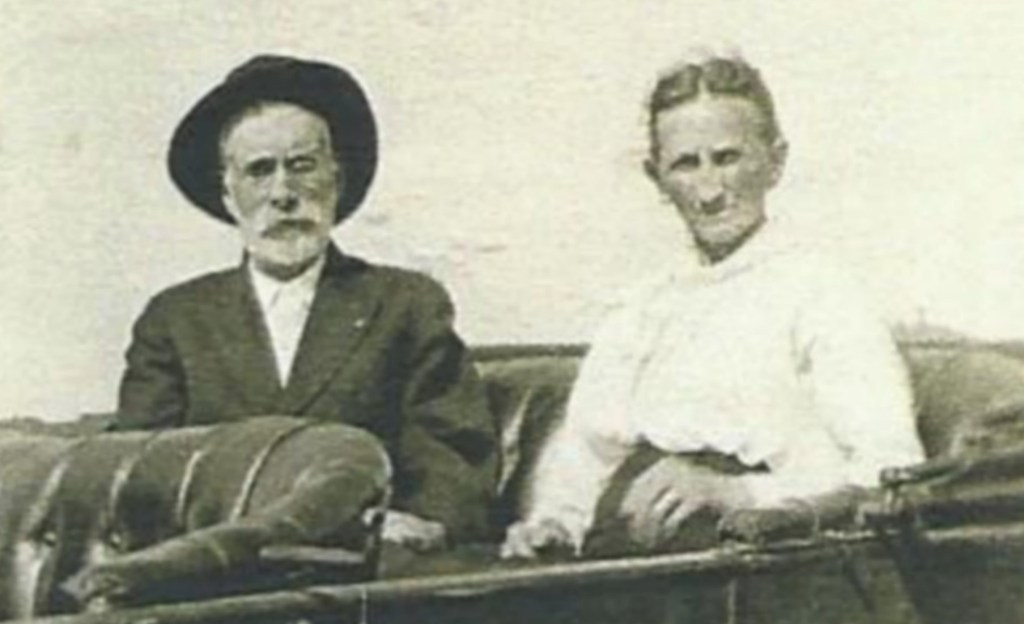
Two subsequent discoveries helped to finally seal the deal for me. The first came from James Morrison in the form of a photograph from 1908, showing Frances Mae and an older sister. Mae would have been eighteen at the time of the photo, just a year from the start of her brief, ill-fated marriage to the twenty-five-year-old David Henderson. My first thought was that the facial similarities, at least in profile, between the young woman here and early pictures of Aunt Genevieve are telling. Unfortunately, I have no photos of Grandma that predate the 1940s, but I did find one in which she is similarly positioned, and I used image software to place it over the sister’s half of the 1908 shot.
My heart raced when I beheld the two images side-by-side. The shared slight retrusion of the chin, the high hairline and prominent forehead, the location of the part, the ear’s gentle curve and the smallish nose left no wiggle room for debate.

The final bit of evidence that cinched this newly discovered connection came while I was reviewing county birth records for you and your siblings. I’d recalled that there was an inconsistency in the record for Aunt Elaine, who was born in 1922. Whoever filled out the birth certificate had, I assumed mistakenly, typed another maiden name for Grandma, which was later lined out and replaced in cursive with “Thompson.”
What could have accounted for this error? Again, speculation led me to pull out her record to double check a hunch. For one thing, I knew that Elaine (like all the Brown children except for you) was born at home. No doubt the birthing process was arduous, and while I’m not sure if any anesthetic was used, I’m certain that Grandma was nonetheless exhausted after the ordeal. I suspect that she might have still been under some mind-blurring effect, whether from fatigue or ether, when asked the questions required for them to fill out Elaine’s birth record. I can imagine the attending physician or his assistant jotting down Grandma’s mumbled answers and taking them back to the office, and that sometime later they were typed onto the official document at the courthouse.
Whether or not my imagination conforms with how it played out I will never know. But the typed document for Elaine unequivocally lists, as Grandma’s maiden identity, “Mae Morrison.”
***
Knowing what I know today, I find I am left with a whole new set of questions. For example, was Grandpa the man that Grandma ran off with in North Dakota? And if this is true, then was he complicit in both the name-changing and the cover-up of their past? I ask this because these are things that would have required some dedicated planning and deception to pull off, especially once you kids grew old enough to reason and wonder about things. On the other hand, if he wasn’t the man, then did he at least know that it had happened? And if he didn’t, then Grandma would have carried twice the burden of silence: the onus of having abandoned David Henderson and her family of origin, and also any associated guilt over concealing it from Grandpa for the five decades they were together before he died.
My gut tells me that Grandpa was that man. Of course, I can’t know this absolutely. And my second cousin, James Morrison, for all the wealth of information he has provided me, cannot answer this either. After all, by the time Grandma skipped off into the night, as it were, and into a future that produced us, the principals of the Morrison family and David Henderson had all pushed farther west, into Montana. Young Frances Mae became an enigmatic, almost ghostly figure in Morrison family lore from then on.
***
By the time of Grandma’s flight from the North Dakota farm in late 1910, Grandpa Brown was out west already, having left Illinois with the youthful dream of becoming a cowboy. In the decennial census enumerated that year, an Illinoisan age-contemporary by the name of William Brown shows up in La Moure County, North Dakota, boarding with a bunch of other laborers in Edgeley and working as a pressman in an office. This would have been an unlikely job for Grandpa if its primary task was setting type (Grandpa could read and spell, though probably not fast enough to be an effective typesetter), but it would have been right up his alley if the job was more labor-intensive, such as working a manual press and spreading ink. I can’t promise with proof that this young man in the census record is Grandpa, but this is the strongest possibility I’ve come across using Ancestry’s powerful search capabilities.
Not only that, but La Moure County is almost a straight line due-south and across the state from Cavalier, where, at the very same time, Grandma was settling in, perhaps already reluctantly, with David Henderson. It is not inconceivable to imagine Grandpa working his way north over the ensuing months, perhaps finding eventual employment, say, on a farm headed by a lonely young woman whose mate was now farther west—effectively out of touch and seemingly a world away.
***
In Grandpa’s story there turns out to have been another surprise that thickens the plot. About a year after discovering that Grandma was a Morrison rather than a Thompson, autosomal DNA and a newly uncovered, solid paper trail revealed that I’d been chasing the wrong name all along. Grandpa was not a Brown. His birth date of November 3, 1889, and oft-stated birthplace Palestine, Crawford County, Illinois were true enough, but he was in fact born William Elmer Ingersoll, son of George Washington Ingersoll, a young schoolteacher, and his wife, Mary Matilda, whose family name was Rooksberry.
Grandpa likely had scant recollection of his father, George Ingersoll, for true to that nugget of information Uncle Kenneth once heard and later imparted to me, George died suddenly when Grandpa was only three years old, leaving Grandpa, Grandpa’s brother Charles, and their mother Mary without support. This hardship was made especially worse by the fact that Mary was at that time pregnant with a third child.
Within a year of George Ingersoll’s death, Mary and her children (which by then included another boy, John) relocated north with the help of her brother. She settled in the Peoria area, and in 1895 married a man named John V. Schmidt—a union that proved short-lived. Either she left the marriage, or he did, but it was a definite parting of ways. The 1900 federal census of Peoria shows Mary living singly again with her three boys in a poor section of the city, in a rear building at 2009 South Washington Street—just a block from the CB&Q tracks, near the Illinois River and within smelling distance of a nearby stockyard.
Somewhat later, in 1903, she married for a third time and relocated to the area surrounding Elmwood, Illinois, a small community just west of Peoria. Grandpa lived there with his mother, brothers, and new stepfather well into his teens.
Then, at some point, young William Ingersoll left home for the West. We don’t know why. And somewhere along the way between turn-of-the-century Peoria and the Dakotas a decade or so later, and again for reasons unknown, he adopted the fictional surname, Brown.
Tempting though it is to speculate, I don’t believe that Grandpa’s name change coincided with or was connected in any other way to Grandma’s decision to invent her own false identity. Something tells me he was already carrying the name, William E. Brown, when they met. Could he have gotten himself in some sort of trouble with the law as a kid and needed to disappear? Was there some falling out with his mother or brothers, and he renounced his part in the family, abandoning them and the surname that had united them? Or did he perhaps harbor some simmering resentment for George Washington Ingersoll, who had died and left the boy not only financially destitute but without a solid father figure? We may never know the answer, for, just like Grandma, Grandpa Brown took the finer points of his secret past to the grave.
***
There is one story that Aunt Genevieve related years ago that now hints that some form of family schism might have left unfinished business for Grandpa. At the time she told me the story, I had simply filed it in my mind as an interesting slice-of-life anecdote. But as with many of these informational nuggets, they sometimes make sudden sense when new discoveries provide illuminating context or setting.
The story Genevieve told concerned a train trip to Peoria that she took with Grandma and Grandpa when she was a child. According to Gen, she noticed during their return to La Crosse that Grandpa seemed unusually withdrawn and obviously distressed about something. She asked what was wrong with him, and Grandma quietly revealed to Gen that Grandpa had intended to see someone in Peoria, but that things had not gone as he’d hoped. That was the extent of the explanation, and nothing more was ever mentioned about it.
But the memory stayed with her: the mystery embedded in the hushed brevity of Grandma’s cryptic explanation ensured its retention.
Luckily, she passed this story on to me during a long-distance phone conversation we had. It was sometime during the early 1990s when I called her from Peoria, where I was still looking for Browns in city directories and census microfilms housed at its public library. As usual, I was coming up with nothing conclusive since, unbeknownst to me, there was nothing to find under that surname.
But fast forward to 2018, and I suddenly have a wealth of new information, thanks to those strong genetic connections and newly-discovered paper trails. I now know my real surname (though I’ve elected to keep it as Brown out of respect for Grandpa and whatever motivated him to adopt it), and I’m in possession of many other names, dates, and locations that I previously could have only hoped for and frankly feared that I’d never secure.
Much of this new information hit me as both surprising and poignant. For one thing, I now know that Grandpa’s mother, Mary Matilda (Rooksberry) Ingersoll, lived until 1923, surviving a full thirty years after the death of George Ingersoll—Grandpa’s father. She was a troubled soul in her later years, suffering from severe mental illness—a form of psychosis the doctors noted in her records—the strain from which she finally succumbed during a lengthy stay at the Peoria State Hospital.
Genevieve Brown would have been six years-old then, a coincidental fact that provided sudden and dramatic context for her childhood memory of that unhappy train trip to Peoria. As I continued to gather documentary evidence, it became more and more clear that the trip was somehow connected with Mary Ingersoll—either her worsening illness or death—and that Grandpa had to have maintained or at least reestablished some form of contact with elements of his original family.
For one thing, in Mary’s obituary the names of her three sons by George Ingersoll, Grandpa included, are listed as being among her survivors. Whoever provided information for that obituary had to have been aware that William Elmer Ingersoll still walked the earth, although, since the notice listed only his given name along with those of his brothers, I am not sure if the person knew he had since dropped Ingersoll in favor of Brown.
The next crucial bits of evidence came by chance, when I happened upon the website of a Peoria county woman whose family’s path ran parallel with that of Grandpa’s younger brother, John Clinton Ingersoll. The site included a page dedicated to John, who had married the woman’s grandmother. The page includes dozens of photographic images not only from John’s adult life, but also many that he must have inherited and kept after their mother died.
One of these images stands among the most exciting research discoveries I’ve ever made: It is a photograph of Genevieve as a baby. I have the very same photograph in my own collection!
Discovering this woman’s website and this trove of images was one of those serendipitous events in a lifetime of family research that leaves me wondering whether my work is at times guided by something beyond my capacity to understand. Among the many other items in the collection are several photographs that depict the elder brother Charles, whom I identified by process of elimination.
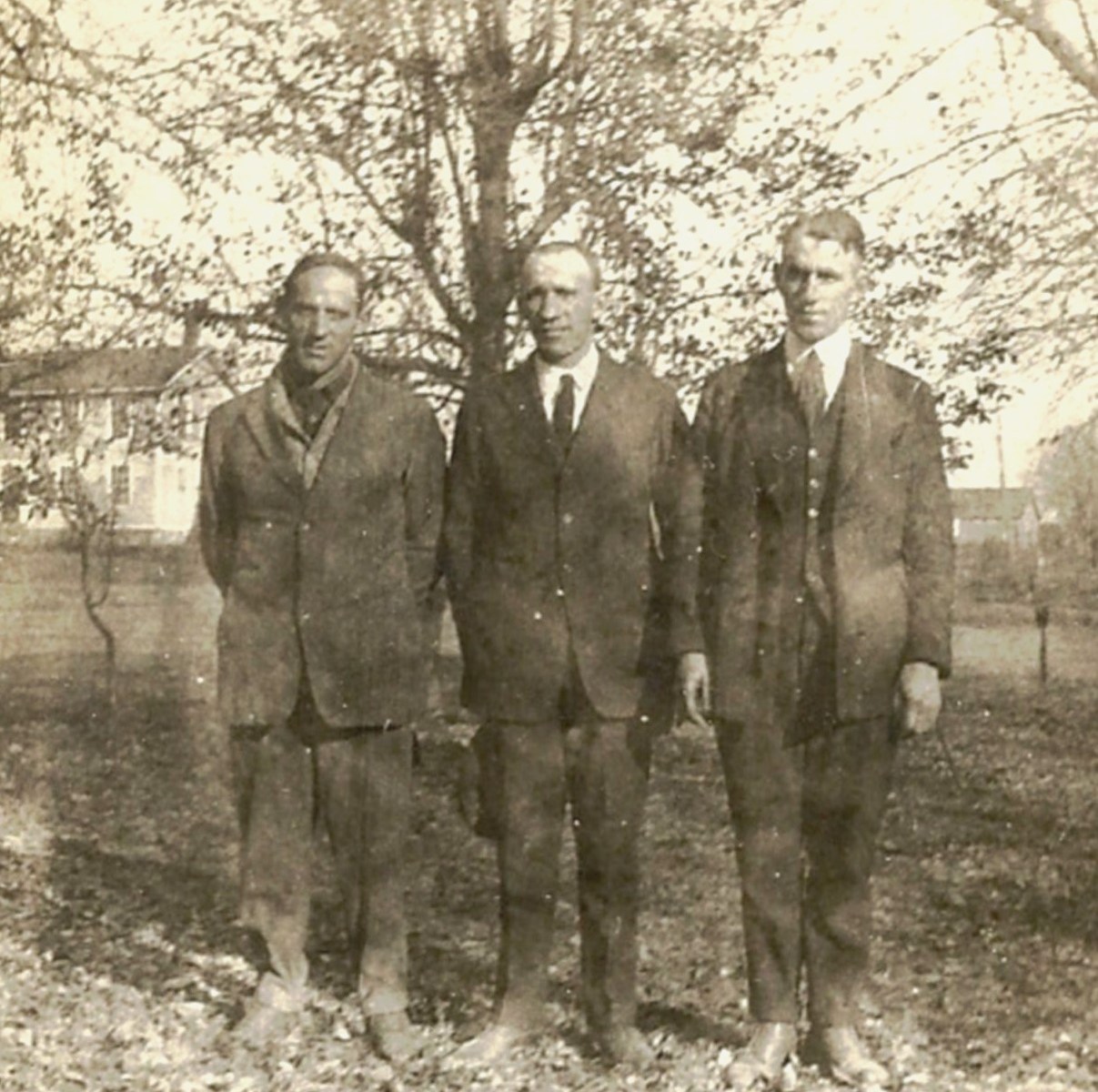
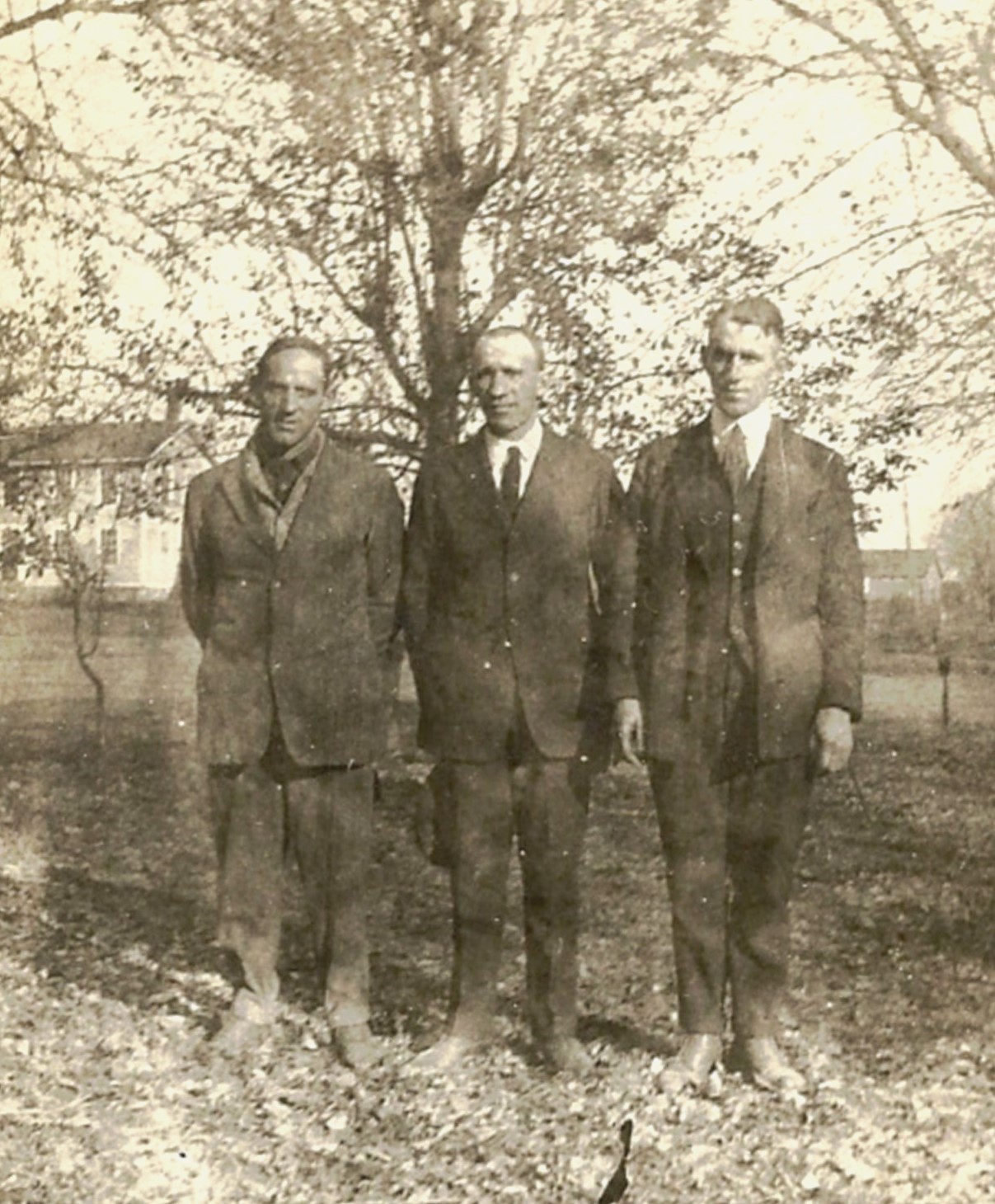
One of these pictures (a group shot posed in a rural field with trees in the background that are clearly shedding leaves) shows Charles and John Ingersoll flanking an unidentified man. The noses of all three men are prominent, as are their ears and heavy brow ridges. The facial constructions alone suggest a blood relationship. Working on a hunch one day, I cropped and enlarged the face of the man in the center, and I spent the better part of an evening comparing it with close-ups of later photos of Grandpa Brown.
There is no question that he is that man.
The distress that Genevieve described having seen on her father’s face in the train car later is quite apparent in this photo as well. In fact, all three men share it. Of course, they are likely grieving over the loss of their mother. But something else seems apparent too: a discomfort in proximity. I can only characterize the scene in the photo as being one of an uneasy truce.
As for precise details of what occurred on that trip to Peoria County, none survive. Still, something definitive must have happened, for the matter that Grandma alluded to in whispers on the train ride back to La Crosse was never discussed again.
***
In the end, whatever Grandpa had hoped to accomplish in Illinois on that trip did not come to fruition in a way that satisfied him, so he pushed the matter aside in his mind as best he could and returned to his work and the life that he had built independent of his family of origin.
And in the veil of silence and untruths that followed, Genevieve, you, and the rest of your siblings would never know the identity of your own paternal grandmother, Mary (who, by the way, was born in Jefferson County, Kentucky, in 1859, to her parents, John Rooksberry and Susan Sarah Colyear). Her line includes generations of farmers and townspeople, Revolutionary War veterans, a handful of Quakers, and even a few Scots-Irish preachers, one of which, the Reverend Hugh Conn, dropped dead while preaching to his congregation near Bladensburg, in the Maryland colony, on June 28, 1752.
And of course, not a word was ever shared regarding the existence of Grandpa’s brothers, the two men flanking him in that 1923 photo. The elder, Charles Ingersoll, as I later learned, sired two children of his own, and later lost the children’s mother to suicide by poison. He remarried eventually and lived on until 1960, when he took his own life with a .410 gage shotgun blast to the chest. The youngest sibling, John Ingersoll, had no children of his own, but he married a woman with kids after he’d first seen the rubbled remains of Europe as a soldier at the close of World War I. John, it is said, drank his morning coffee not from a cup but rather from a bowl. He was fun loving and knew how to have a good time. And he outlived Grandpa Brown by ten years, dying in Peoria in 1979 from stomach cancer.
Combined with the many unknown and unmet siblings on Grandma’s side, these represent the host of relatives who, in a different reality, might have been around to watch you all grow: blood relatives that produced cousins you would otherwise have grown up with—collectively, a true extended family that might have joined you on holidays and at summer gatherings and, by their mere presence, would have added to the cornucopia of stories, traits, tendencies, and familial connections that we, your children and ours, have come to know all our lives, and take for granted in ways that none of you could have ever imagined.
 Rick Brown Writes
It’s like finding a magical treasure, finding your roots, once buried. What a wonderful chapter!
LikeLiked by 1 person
Thank you so much, Amy!
LikeLike