
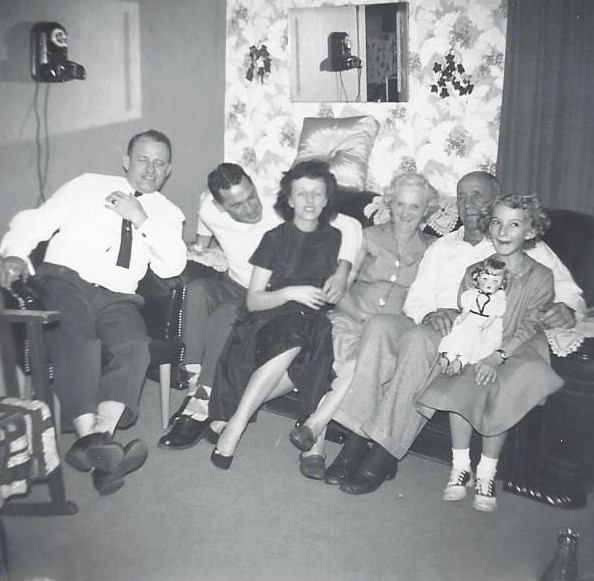
A World from Nothing
My two earliest memories come as flashes. You are prominent in both.
In the first, I am two years old. You have carried me up the long and steep staircase to Grandma and Grandpa Brown’s apartment on the north-side of La Crosse, Wisconsin. The stairwell is dark. It is an old house. Mom is behind us on the stairs. I don’t know how I know this today. I do not see her in the memory. But she is there. We reach the top, and an ancient, paneled door opens to the sight of Grandma Brown. She is smiling.
It begins and ends like that: a visual cloud-break of recollection. Yet I suspect there is some importance to it, for I still feel a warmth as I recall this glimpse today. Could it have been winter, and I’m bundled against the elements? Was something cooking on the stove at the apartment, perhaps in grandma’s pressure cooker, and I was feeling the heat escaping through the opened door?
Or, more likely, was I simply warm in the refuge of your safe conveyance?
The second memory is of a summer night on the front porch of our split-level redwood rambler on Hoeschler Drive, on the south-side of town. We are all together: you, me, and Mom. We have overnight visitors, too. Mom’s sister, Zenna, and two of her daughters, both teenagers, are up from Indiana for the weekend. Fireflies dart about, a dreamlike spectacle that I enjoy to this day. I hear the ring of crickets and cicadas out in the grass and amid the junipers and arborvitaes that border the porch.
At some point I step off the porch and toddle around the side of the house, following the fireflies. I’m alone, and the grass feels cool, dewy, and delicious on my feet. Only later in childhood—like when my bare foot slides over a fresh dog turd for the first time, or when I step on an exposed metal tent stake and sustain a deep, V-shaped cut on my sole—will I begin to develop a visceral aversion to walking without shoes on grass. But none of that is present on this night.
The narrow side space between our house and the neighbors’ is dark. I’m alone, but it’s okay. I don’t know why I’m okay. A year or two later, a similar separation might trigger an anxious response or even a panic. But not on this night. Maybe I can still hear your voice in the near distance.
Or maybe I just believed in myself, of myself, right then. Maybe I didn’t need an outside reason to be secure, to feel okay.
More than a half-century later, these two memories remain as symbols of the tug-of-war that rages inside me: An often-desperate need for the warming, life-affirming esteem of a loved one (you being the first) and the equally fundamental desire for separateness, to be a person of my own making.
***
Why do we remember certain events but allow the memories of others to slip away? Is it just a random process of mental house cleaning, or are there formative, educative reasons for keeping them?
And taking that thought a step further, might those retained memories trickle down in some manner or form to influence the lives of subsequent generations? Are some of the things that we take for granted regarding our private fears, behaviors, preconceptions, or repeated life patterns the echoes of hard lessons learned (or not learned) by ancestors we never met?
I have a good memory, as did you, but they manifested differently during our lives together. Mine is episodic, full of big-picture stuff that I compare with big-picture memories of other experiences. But I am often at a loss when it comes to describing individual trees in the forest. On the other hand, your grasp of detail was impressive. You not only remembered the many games of your high school football career in the early 1940s (when you were one of the two fastest young athletes in the city), but you could recall scores and individual plays. You were great with dialogue, too, and could recount word-for-word conversations you had as a young child.
Your memory was a useful and welcome window into our family’s past, at least as far back as any of us could hope to glimpse without the benefit of science. Grandma and Grandpa Brown were always loath to reveal much about their origins to you and your siblings. What little they did say was often misleading or conflicting, and much of it has since proven to be falsehood.
You never knew anything about your own grandparents—not even their names. You grew up without uncles, aunts, or cousins. How did that feel? Did you not sense a tug in your chest when neighbors hosted their own family holiday gatherings? Did you ever note with jealousy, or even resentment, the plentitude of cars parked outside their houses when you walked alone through the late December snow, or bristle at the sound of unfamiliar young voices mingled with those of your neighborhood friends on Thanksgiving?
There had to have been questions. You often wondered why your two older sisters, Genevieve and Elaine, never asked your mom enough about the past. After all, they were always “around the house,” as you put it, helping her with the laundry, cooking, and other tasks. If ever they did ask Grandma and Grandpa about their origins, Elaine and Gen didn’t press the queries too far. Years ago, they both separately admitted to me that they had been afraid to ask, wary of reawakening Grandma’s indefinable sadness or provoking Grandpa’s volatile moods. But you and your brothers could’ve inquired too. It wasn’t like they were the only ones around the house.
Oh yes, your parents dispensed nuggets of information over the years, but never anything comprehensive. And sometimes they told each of you conflicting versions of events and details, deceptions you didn’t discover until after they were dead. Aunt Elaine said that Grandma once claimed she’d lived comfortably as a child, that her family had owned horses. Conversely, Genevieve’s understanding was that Grandma’s mother had died in childbirth in Iowa, and that her early years were spent in the care of two spinster aunts. You yourself recalled hearing a tale of Grandma’s time in the Dakotas, where they had to string a rope from their back porch to the outhouse, lest someone should lose their way at night during a snowstorm and freeze to death.
And Grandpa dropped a few clues too. He told your brother Kenneth that his own father had died when he was three, and that he finally left Illinois while still a young man, heading for the Dakotas, intent on becoming a cowboy. He also claimed to have seen Geronimo perform once at an amusement park. Maybe seeing the old Indian dancing and sharing stories inspired him to leave Illinois for the open country west of the Mississippi.
But you could never really know, and certainly never verify, because the nuggets he and Grandma dispensed were always few and disconnected, and the rich ancestral vein that you and your siblings knew had to exist was never discovered during Grandma’s and Grandpa’s lifetimes or, sadly as it turned out, during yours.
It was as though your little family sprang fully-formed, without antecedents, in La Crosse, Wisconsin around 1915—roughly the time that Grandpa told you he and Grandma arrived in the city by train and took a room at a downtown hotel. According to what he’d said, they liked the area and decided to make La Crosse their home. In short order their first child, Genevieve, was born. Then, in 1919, came Raymond. Then Elaine, and Kenneth. And finally, on June 1, 1927, you arrived: Richard Paul Brown.
Just like that. Or as you once described, it seemed to you kids as though “the world started” when you were born.
Given all the misinformation over time, I wonder whether that single detail of Grandma’s and Grandpa’s arrival in this small Wisconsin city on the Mississippi River is the only genuine, perhaps grudging, admission they made about their situation prior to Genevieve’s birth.
Of course, the onus of having not pursued answers to the mysteries of our family doesn’t fall exclusively on you and your brothers and sisters. I could have asked too. Indeed, it is one of the principal regrets of my life that I never did.
Of all the people in our family, perhaps I am best suited to have done so.
If it can be claimed that each family has at least one individual who is obsessed with its genealogy (often to everyone else’s annoyance), then I am that person in ours. My near-pathological fixation on the past has been with me for as long as I can remember. I cannot walk by an aging building without musing over the human lives that played out within its confines. I can (and do) spend hours examining census records and newspapers captured on microfilm. I connect deeply with old photographic images, whether they depict people or not, and I often draw an odd sense of nostalgia for time periods I’ve never lived through, especially when listening to music specific to an era: Joplin rags, 1930’s big-band, Sousa marches.
Perhaps it was no surprise that when I finally returned to college at the age of twenty-seven to complete the undergraduate studies that I had abandoned years before, I wound up declaring a new major, one that best served my time-obsessed nature. I chose the discipline of history.
So yes, I am frustrated that I never took it upon myself to broach the topic way back when, especially with Grandma Brown, who lived until I was a senior in high school. Being who I am, it was the obvious course to have taken. And I squandered my chance.
But maybe, like the rest of you, I was afraid of distressing her. It always seemed like such an easy thing to do.
I recall Grandma Brown as a kind, loving, but agonizingly morose person. She could be a real killjoy in the way she pouted over people drinking beer at family gatherings, or playing poker for even small stakes, pocket change. I suspect this unhappy aspect of her personality gained more ground later in life, but from what I’ve heard from Elaine and others, she’d always seemed to be bearing the weight of something troubling. There are a few photographs from far back, before I was born, where she is smiling, even some where it looks as though she’s laughing. Yet no one would ever have argued that she embodied a joyful spirit, and especially not in the years following Grandpa’s death, when just about any conversation with her coursed ultimately to her wish that she could die and join him in whatever afterlife she envisioned for the two of them.
I’m not sure if hers would have been a Judeo-Christian-style heaven or a less-defined, non-denominational realm, though I rather doubt it resembled the former. Grandma and Grandpa Brown weren’t religious by any stretch. While Grandma didn’t pay much attention to matters of faith, Grandpa Brown was more overt in his opposition. I don’t know whether his distaste was limited to Christianity or if it encompassed the totality of organized religion. Given his coming-of-age time (the early twentieth century) and his socio-economic status (white, American-born, insufficiently educated, poor), I can’t imagine there were many options for him beyond Christianity or possibly (though far less likely) Judaism. White Americans from that period and social place typically didn’t shuffle off the norm to dabble in, say, Hinduism or the musings of Lao-Tzu.
Grandpa’s everyday world from the time of his early childhood was about survival: maintaining an income in order to eat and provide. His life played out in the immediate present. Whatever his past entailed, all indications are that he stepped away from it at some point and just kept going. As for the future, whether here or in the hereafter, he had neither occasion to, nor interest in, pursuing any such notions.
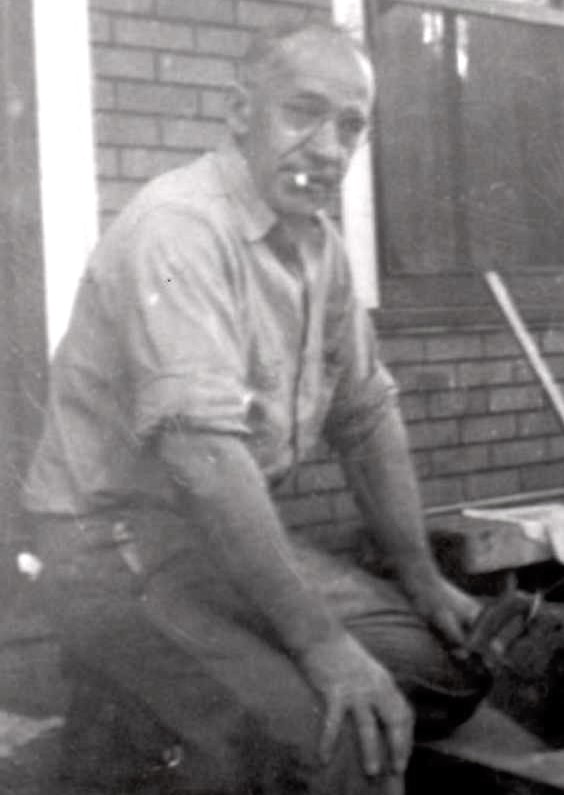
Of course, lots of poor folks go to church. Indeed, people in more dire straits than Grandpa Brown ever faced become deeply committed to religion. In many cases, it’s the one buffer standing between them and utter desolation.
You had always suspected his stand against religion was founded on pride: namely, that he never attended church because he wouldn’t allow people to see he lacked money to drop into the collection plate. But I think it ran deeper than that. Witness the vehemence he displayed when you were baptized at the age of eighteen, at the insistence of your sister, Elaine, who feared for your soul after you’d joined the navy near the close of World War II. A Methodist minister, probably Elaine’s, showed up at the house to perform the rite, but before it began Grandpa took you aside and remarked that, while he wouldn’t stand in the way of your going through with the ceremony, he thought it would be just as effective if he were to climb a ladder and piss on your forehead.
A comment like that leaves little doubt that Grandpa Brown thought church was a bunch of nonsense. But why? Part of it, like you said, was the ingrained pride (or insecurity) that prevented Grandpa from exposing himself and his poverty during the very public tithings at weekly services. Nothing to him was more humiliating than conspicuous helplessness, and a man who couldn’t make his own way in the world and provide for himself and his family was not a man at all. So vehement was his distaste for “the county” (a contemporary term for public assistance in the 1930s), that he once visited holy hell on Genevieve when he discovered a bushel basket of groceries left at the doorstep of the place she shared with her new husband, Al. As you relayed it to me, Genevieve protested ignorance about the basket, but to Grandpa it didn’t matter that neither she nor Al had signed up for a county handout. The mere fact it now sat outside her door in plain sight was intolerable enough.
“You call up and tell ‘em to pick this son-of-a-bitch up,” Grandpa roared. “We don’t want nothin’ for free!”
You were just a kid then, maybe ten, and your takeaway fear was that he was going to kill Genevieve over it. A little hyperbolic on your part, perhaps, but a kid’s impression of something like that is a lasting one, and the lesson it carried regarding self-reliance was not lost on you.
Just as Grandpa wouldn’t abide the embarrassment over someone in his family pleading a case of need to county officials, I think the same conviction to be his own man also applied to matters of religion. Like you said about Grandpa regarding baptism: “He didn’t think that water meant anything.” To him it was a tool, a gesture thought up by men who wanted to control other men.
Of course, we’ll never be able to plumb the depths of his conscience. He may have privately believed in what many folks in recovery, like me, call “a power greater than our self.” He may even have called that power “God,” if for no other reason than a lack of known alternatives. Whether or to what extent he might have held this outlook or conviction is something he took to the grave.
But I think you’d agree it’s safe to say that he’d be damned if he’d let some minister or dogma rope him in or tell him how to run his life and that of his family. You can go ahead and let Elaine bring this guy in to pour water over your head and promise salvation, Grandpa might have been thinking when he pulled you aside that day, just don’t make the mistake of signing away your personal freedom.
I’m only speculating here, but it fits with things you and others have told me about his patterns of resistance. He frequently bristled at figures of authority: especially men (always men) who used their more fortunate positions to belittle others or to push them around.
You well described Grandpa as a proud though painfully self-conscious man who wouldn’t let anybody run him down, no matter how high their station. I always loved the story about the engineer who dared complain about the water temperature at a depot where Grandpa worked during one of his stints as a janitor and general laborer for the Burlington railroad. You and Grandpa, having both worked for the railroad at one time or another, shared a mistrust and disdain for the “white hats”—the engineers, conductors, and higher-echelon employees who often lorded their status over you blue-hatted workers who pounded stakes, loaded mail sacks, and generally performed the physical tasks. As you retold the story you’d heard from Grandpa, a specific engineer sauntered into the depot one day and started washing his hands in the sink.
“Jesus Christ,” the engineer berated Grandpa. “Can’t you even get the goddamn water hot around here?”
“Yeah, we can,” Grandpa said. “We’re havin’ problems right now, and I’ll fix it. But I’ll tell you one thing, you son-of-a-bitch: I know when you drive up here. Every fuckin’ time you come here the water will be cold.”
And this was no isolated incident. Some years after the cold-water confrontation, Grandpa went back to the railroad for work, transporting engineers from La Crosse to the Dayton’s Bluff depot in St. Paul. By this time, he was in his sixties. You had taught him how to drive a car so he could take that job, with minimal success it turned out. The practice runs that you took with him around town were next to terrifying, and on the very first day in his new position, Grandpa pulled out of the depot parking lot and hit another car.
On one trip to St. Paul, he had a carful of white-hats, and a cocky engineer named Taylor (in your description “a mouthy bastard: wild, drank, screwed around…”) was giving Grandpa a hard time about his driving. Grandpa put up with it at first, but the other man wouldn’t let it go.
Suddenly, Grandpa stopped the car on the side of the road, got out and said, “You know what? I’m not afraid of a son-of-a-bitch like you who can’t even take care of his own family. You get outside and fight.”
There is a radar that men have when it comes to other men, I think. I’ve experienced it myself. I can tell from a look in someone’s eye and the tone of their voice that they mean business when it comes to threatening violence. Serious people put off a certain energy that way. When you sense it, you know there’s going to be a fight. There’s no bullshit posing involved. I have no doubt Grandpa would’ve clocked that guy on the roadside that day if things had been allowed to follow their natural course.
Apparently, the other engineers sensed it too, because Grandpa heard one of the men inside the car say, “Taylor, you’d better sit where you are and shut up, or I’ll kick the shit out of you.”
That settled the matter.

