
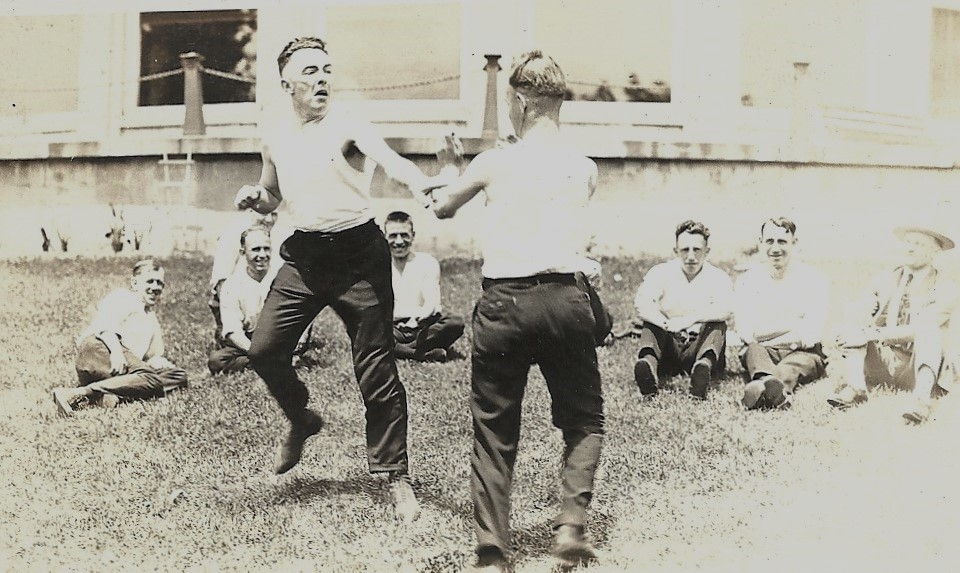
Bristling and Posturing
No one at Harry Spence Elementary would have uttered the words “tough” and “Rick Brown” in the same sentence, not even after that game-winning catch in sixth grade and all that it opened up in terms of athletic potential. For out of all the opposites in that Armour hot dog jingle, the most damning one for me as a kid was the juxtaposition of “tough” and “sissy.” That was one trap I could not crawl out of in those early years. Because the accepted way to establish one’s place as one or the other as a boy back then was through fighting.
One night during the early 1970s, you, mom, and I went out to eat at the Cerise Club, a nice place on the south-side not far from our house. Afterward, we drove to a nearby bar, Dugan’s Dugout, for after dinner drinks: whiskey Manhattans for you two and a kiddie cocktail for me.
I liked Dugan’s, mainly because the jukebox had “The Irish Washerwoman” on it—a lively jig that I liked to hear again and again. Perhaps it was because of my habit of playing that tune over and over on that jukebox, but somehow you got involved in a verbal face-off with another patron. It started with insults thrown back and forth and culminated in you telling the guy you wanted to step outside with him.
One thing that codependent people do extraordinarily well is to read a room for bad vibes. Being just that type, I have an Obi-Wan Kenobi-grade vigilance for disturbances in the force caused by human conflict, which kicked in on that night. I can’t speak for Mom because, like a turtle, I went inward at the first sign of trouble and checked out, but in my own mind I was sick with fear that you two were going to duke it out in the parking lot. I’m not sure what eventuality I feared beyond the fight itself. Did I think the other guy was armed and you’d be killed? It’s possible, since losing you one way or another was a perennial fear of mine in those days. Did I think you’d be beaten up and humiliated? Not as likely. Back then you could truly scare the shit out of me, so it would’ve seemed implausible that you could ever lose in a fair fight with another man. As tough guys went, you were the toughest I’d ever encountered, if for no other reasons than for that chilling look or the speed and power behind your slap or spank. Might I have thought I’d have to join in with you to defend our honor? Maybe. Even though I was probably in third or fourth grade at the time, my imagination would have easily stretched far enough to envision a scenario where I’d have to join in a fight along with you and another adult, and to make it a situation where backing down would be the worst form of humiliation: the indelible mark of a sissy. That prospect, though unlikely to ever play out in real life, would have scared me nearly as much as the chance of losing you to a killer.
Luckily, somebody in the bar intervened in time and told you both to calm down and, in the end, nothing happened. We finished our drinks and went home. Needless to say, I didn’t play “The Irish Washerwoman” anymore that night.
This incident illustrates one of the many outward differences between you and me, and it has stood as one of many unfortunate examples during my lifetime of defining (or in truth, doubting) my status as a man.
Men don’t go inward during moments like this, the examples teach. They wade into the fray. Not only that, but they prevail. They’re like gorillas, or at least that’s how I see them: bristling and posturing, loud and threatening, chest-beating displays of omnipotence. Tarzan was a man. Daniel Boone was a man (the show’s theme song even proclaims it). In the Charles Atlas ad, Mac didn’t become a “real” man in the eyes of his girl until after he’d bulked up sufficiently and cold-cocked the bully on the beach. In short, he prevailed.

Not that I didn’t try. And as for bullies, I had my own teaching experience with one during my teens. I was in the eighth grade at Longfellow Junior High when, after football practice, a bunch of us had gone to see the ninth-grade team play Lincoln. I was stepping away from the game at one point when I noticed a Lincoln kid, another eighth-grader like me, pushing a smaller Longfellow kid around while his buddies watched and giggled.
Obviously, I don’t go looking for this kind of stuff, but seeing that going on bothered me. Plus, the kid being bullied was someone I knew going back to elementary school. Without giving it much thought one way or another (in other words, without talking myself out of it), I walked over and basically told the Lincoln guy to knock it off. I think I even pulled out the old cartoon cliché: “Why don’tcha pick on someone your own size?”
At that point, the guy suggested me as an alternative, and for reasons I’m still not sure of, I said fine. We squared off then and there. It was to be my first of two bona fide street fights so far in my life.
I didn’t land a single punch that afternoon. I just didn’t know how to do it. Lots of swinging into thin air. Over the previous couple of years, I had learned how to execute an effective block against a defender on the line of scrimmage. I also learned and mastered the proper technique for tackling an opponent’s ball carrier. But that was football, where both the stakes and the rules were different. This was a street fight, and one of several lessons I learned on this day was that fighting in this manner is not like organized athletic competition—that is, nothing like the Ali-versus-Whomever boxing matches I watched on TV. There was no rope-a-dope going on here, no floating like a butterfly, either. And the punches that landed on my own face didn’t feel like bee stings. They were blunt-force and bloody-ing. They made my eyes water like I was crying. (And yes, I still feel the need today to insist that I was not.)
The guy’s buddies, who had been snickering during the bullying incident a few minutes before, broke into full-bore guffaws over my ineptitude as a fighter. I remember that part well. I don’t recall who ended the fight, him or me, but I do know that we parted ways both vowing to finish it on the field at our own upcoming Lincoln-Longfellow football game. I made light of it all to some friends afterward, quipping something like “Well, I’ve had my fight for the day.” But I felt both a physical and an emotional fallout from the whole thing. It’s a heavy, dreary pall that remains after so much violence and adrenaline. Plus, I had yet to go home and explain what had happened to you and Mom. There was no way to avoid the issue. I had the beginning of a black eye on the right side of my face and a smashed-up nose that, some years later, I’d find out had caused a deviated septum.
I should probably point out to any reader here that my fear was not one of you finding out I’d been in a tussle. Rather, it lay in coming to you with the admission that I’d been beaten up in a fair fight with another boy. I had no idea how you would react, but that really wasn’t the issue. I simply couldn’t envision myself in that position. To me, there was probably nothing more shameful to admit—to Mom, sure, but especially to you. So instead, I made up a story about having accidentally run into a goal post face-first at practice that day. I even laughed in feigned self-deprecation over the fictional incident. Clumsy me.
A few years later, when you and I were drinking beer and my tongue was lubricated, I admitted the truth about what had happened that day. I remember where we were sitting in the house when it happened—you on that barstool in the kitchen, me on the sofa in the living room, sitting forward and trembling slightly like I often did when I was conveying something to you that was important to me. I told you the whole thing that night: the ninth-grade game, the bullying, the fight that followed. All of it. (We always did have some very candid talks in the days when we drank together.) And I reminded you of the bullshit story I’d told about running into the goal post. When I was finished talking, you were quiet for a few moments. I settled back on the sofa and let out a sigh, not quite sure what I felt about my sudden, impromptu bit of candor. That’s when you broke through our brief silence.
“So, you stood up for that smaller kid, huh?”
I looked over at you. “Yeah.”
You set your cigarette in the ashtray, got off the stool and crossed over into the living room. You stood over me.
“I want to shake your hand for that,” you said. And that’s what you did.
Over the years in my adult life, I found much fault in you, so much and so often that I lost track of the state of balance that every family relationship, indeed any relationship at all, embodies when looked at in the long sweep of a lifetime. There is the good and the bad, but often we get so inexorably tied up in the bad and that balance is skewed, and it’s all we see. And anything resembling a poignant, tender moment between us is glossed over in thought, greeted with suspicion, or rejected outright from consideration. I never once told you during the remainder of your life how crucial it was for me to experience that handshake in the living room. I had years, decades, of learning to do from that point, and decades of horrible mistakes and missteps looming in my future. As did you in yours. And because of this there were bound to be a lot of clashes between us. It was a bullet that neither of us could dodge.
But that gesture was a big deal to me, and I know now that I should have acknowledged it as such at the time. Instead, I just mumbled a lame “thank you,” and the moment, the opportunity, passed and died.


Typo in last sentence of FIRST paragraph.
LikeLike
Thank you! Last minute revision and i misspelled. Good catch.
LikeLike
Great reading and it reminded me of my husband’s relationship with his dad. Also he went to Longfellow School. I know he got into some scuffles but wasn’t much of a fighter either. Looking forward to your next chapter.
LikeLike
Thank you, Judy! When was ypur husband at Longfellow?
LikeLike
Long before you were born. We still drive past there and the neighborhood when we come back to La Crosse every fall. The Old Timer from the La Crosse Tribune sports page was his dad. Bobby Lamb wrote the articles about him.
LikeLiked by 1 person
I grew up not too far from you two: Hoeschler Drive, about twoblocks from Central. Happy 60th anniversary by the way!!
LikeLike
Each time I read this anecdote, I am struck – no pun intended – by your brutally honest account of the scuffle. I see how the incident must have reverberated in your soul with every kick and punch delivered in tae kwon do, a sport in which you excelled.
LikeLike
Hi Nikki: It’s weird–ever since I’ve studied martial arts, I’ve never had another physical confrontation outside of sparring. The only two legitimate street fights I’ve ever had were that one in eighth grade and one the night before my senior year. On both of those occasions, my opponent beat the tar out of me, haha.
LikeLike
That moment, not sure what your dad was going to do, had me holding my breath and I didn’t realize it until I read that next line and an unexpected sob broke. I went through some similar experiences.
I don’t think the way you responded was wrong in any way. It was a respectable response. What else needed to be said that isn’t wrapped up in those two words?
LikeLike
Thank you for checking in with your thoughtful comment, Amy. I appreciate you!
LikeLike