
Coming Home
You taught me the right way to wash walls: Start at the baseboards and work your way up in vertical sections. That way, if a trickle of soapy water runs down from the sponge it won’t cut through a space of dirty wall and leave a mark that’s almost impossible to wipe clean.
You taught me how to mop floors using the ditty you’d learned in the navy: “Swab the deck to and fro, get the corners as you go.” You taught me to vacuum properly, introduced me to the lemony smell of Pledge, underscored the importance of emptying ashtrays, and reminded me to always put on a new roll of toilet paper if company was coming over. And over the years back then, you, Mom, and I kept the old house on Hoeschler Drive well-ordered and next to spotless. For a family of three two-pack-a-day smokers, all with alcoholic tendencies, I’d say we did well.
But that was long ago. I’d long since moved away, failed my first attempt at college, drunk my way out of one marriage, sobered up, and walked away from a second. I’d quit the flower shop, gone back to earn my bachelor’s degree in 1993, gone on to UW-Milwaukee after that and earned a Master of Arts in history in 1995.
During the late-1990s and early-2000s, I worked variously in the history field as an archivist, a property use researcher for an environmental company, and in running a county historical society. In between these gigs I sold hearing aids, delivered flowers back at the shop when I needed extra money, and once worked briefly for a corporate headhunting firm making cold calls to survey prospects for new jobs at the places where they currently worked. That gig always seemed a little predatory. I’d usually have to talk my way through a suspicious receptionist or secretary before reaching the prospect. But the pay wasn’t bad, and anyway, I had no intentions of staying long at it. I didn’t.
Mom died in February 2003, nine days after her seventy-fifth birthday. You passed in November 2006—seven months shy of your eightieth. I inherited the house on Hoeschler after that, and I planned to move in as soon as I could have it restored.
Before this, for over three years, I’d been living in an apartment complex on the south-side. My place was a nice upper, with a little balcony and friendly neighbors, mostly older folks. I kept it in immaculate shape. I had Sophie part time then, so she spent a lot of her childhood in that apartment. I read Stone Soup to her, over and over. I once made a tape of her reciting the entire book by memory. We checked out movies at the video store not even a half-block away from our building—Yellow Submarine, Looney Tunes, just about everything Scooby-Doo. I kept my music equipment stored along a wall of my bedroom, and I hosted practices with an acoustic combo. We’d set up the P.A. and mics in the living room, and never once did my neighbors complain. I was also part of a writer’s group that gathered at my apartment monthly for nearly three years to share our work. We were all doing fiction stuff. I wrote much of a novel manuscript while living there.
For the most part, I considered it home, and that space of my life was generally a happy one. I started running seriously then; at one point I was logging ten miles three times a week. I practiced Kundalini yoga and read a ton of books. The energy at the apartment was one of a creative, contemplative nature, and I felt very much alive, awakened in a way that I had not been for a long time. Like those years in the early 1990s when I’d returned to college, it was a “Larry Darrell” time: my personal reenactment of The Razor’s Edge.
By contrast, in late 2006, the now-unoccupied house on Hoeschler Drive was still there in physical form, but the old esprit was gone—a fact made evident to the eye, the nose, and even to the touch. The furniture, cabinets, and paneling were now sticky with smoke residue. One swipe of the finger left a smell on the tip that would last the whole day.
I had to throw away far more than I kept. There was simply no way to salvage all the many wall hangings, books, table lamps, kitchen cabinetry, and knick-knacks I’d once hoped to save. The plastered walls had yellowed to the point where no soapy sponge would alter the tinge, no matter whether you started at the bottom, top, or the middle.
The signature mid-century picture window in the front living room still opened out to the light of day as it always had—an eastern exposure that made mornings at the house seem glorious to me as a child, and even as a moody, hungover teenager. But now the incoming light only illuminated the galaxies of dust motes floating about in the living room air; drew attention to the mummified cat hairballs dotting the threadbare shag carpeting; cast into tragic glow the urine-stained sofa where Mom had spent much of her final year, sleeping away her limited time.
***
I started cutting and rolling up carpet two days after your funeral. A few pieces of furniture I wanted to keep, but they needed refinishing, so I sent them off. One of them I used to crawl beneath when I was a little kid: an oval-topped, Lane French Provincial coffee table with its curved, cabriole legs and knobby feet. Those were a mid-century staple for those who weren’t too keen on the clean, spare modern stuff of the period, and the table was part of a set that included end tables.
While turning that coffee table over to move it I discovered that, even after all the years between then and now, I was just as familiar with the underside as I was with the top.
I began to rediscover oddities I’d long forgotten about as I moved items, tore up carpet, dismantled fixtures, or simply walked around the property. Just inches shy of one corner of the living room wall, near the south end of the front picture window and normally concealed by the gathered mass of heavy drapery, there is a tiny concavity in the plaster, surviving evidence of a single fingerprint. No doubt it was left by a worker hurrying to finish the interior of the house around 1960. Another similar urban fossil that I rediscovered was outside, in the concrete gutter at the foot of the double driveway we shared with our neighbor: a near-perfect paw print left by what had to have been a large dog, probably during the late 1950s. We even intentionally created our own urban fossil in 1974 when, after some home project, you had leftover wet cement in a bucket. You dug a shallow, circular form in the lawn by our back door, poured in the cement, and the three of us contributed our impressions for posterity. You stepped your bare foot into the cold mixture, Mom pressed her hand, and I knelt and stuck in the tip of my nose.
But it wasn’t just odds and ends that reawakened my sense of wonder about the old house. Rooms and other living spaces carried their own energy in the form of the still-reverberating stories they retained. In 1970, you and Mom had an addition put onto the back of the house, creating what we always called the sunken dining room. And it was a dining room in the sense that we put a table and chairs there and ate in it often. But that step-down, open-concept room became the primary center of activity in our home. We put our main TV in there, along with two recliners and an armchair. In keeping with the 1970s interior trends, the room had glittery gold wallpaper on two of the three walls. And on the entire third was a wallpaper mural depicting a Mediterranean seaport scene.
Laughter is the sound that echoes in that room for me now. It’s where we three gathered to watch the great variety shows of the 1970s like Carol Burnett and Sonny and Cher. There were the classic sitcoms and special programs too: “All in the Family” (Mom and I considered you our very own Archie Bunker); “M*A*S*H”; and the many Dean Martin celebrity roasts on NBC, where the mock-drunken banter between Martin and Foster Brooks always kept us in stitches.
In those days, drunkenness was still a form of comedic entertainment to me, a sort of vaudeville shtick. For the most part, I hadn’t yet made a solid connection in my mind between alcohol and alcohol-related problems. There were exceptions of course, like whenever you’d order a martini at a restaurant, I could bet that you and Mom would be fighting by the time the entrée arrived. And of course, just about every fender-bender we had was traceable to your having had a few too many drinks. But back then, in the early- and mid-seventies—before your addictions took full control and you and Mom became pathetic caricatures of yourselves—I still equated alcoholic consumption mostly with goofiness.
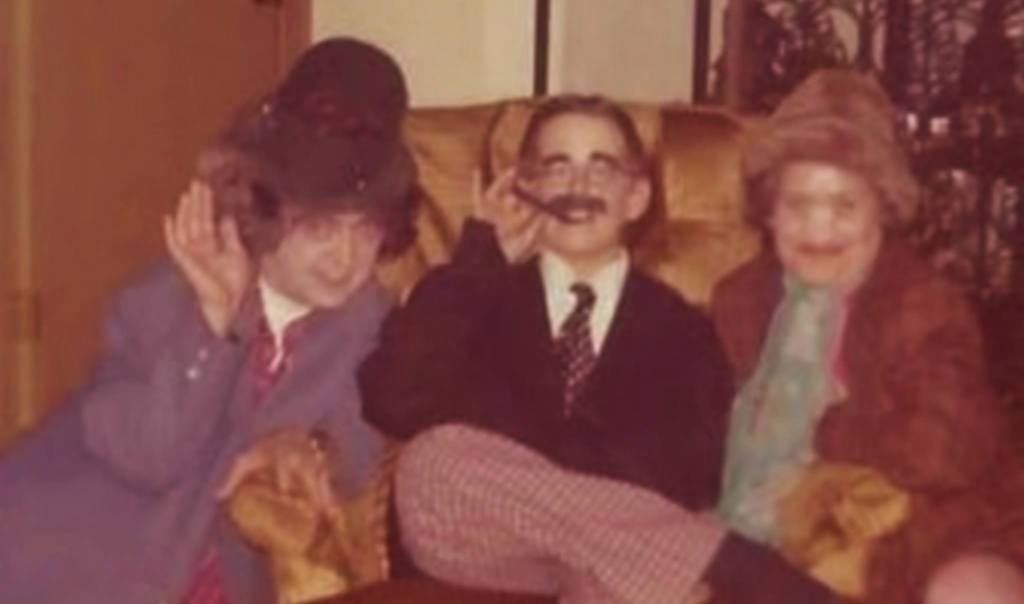
Among my favorite evenings back then were the times when Mom’s sister Zenna was in town from Indiana. Zenna was a prodigious drinker in a family of big drinkers. Years later, in the 1990s, she contracted liver disease and lost a portion of that organ through surgical resection. She quit drinking altogether after that and lived the remaining fourteen years of her life sober. But in the Seventies, Zenna still loved her Screwdrivers and beer, and thus she fit in swimmingly at our house. She was a favorite aunt of mine, one who always saw the humor in life and made the most of it. On the nights when she’d come up to stay, you three would enjoy your cocktails and I’d drink my Spring Grove pop. And at a certain point in the evening, we’d often stage a costume performance party—raiding the upstairs closets for clothes, hogging the bathrooms to apply makeup, then descending the stairs to make our appearances in the sunken dining room. One time, Zenna, Mom, and I transformed ourselves into the Marx Brothers. Zenna and Mom became Chico and Harpo. I cut a paper mustache and eyebrows from black construction-paper, fashioned a pair of round wire-rimmed glasses, and assumed the part of Groucho.
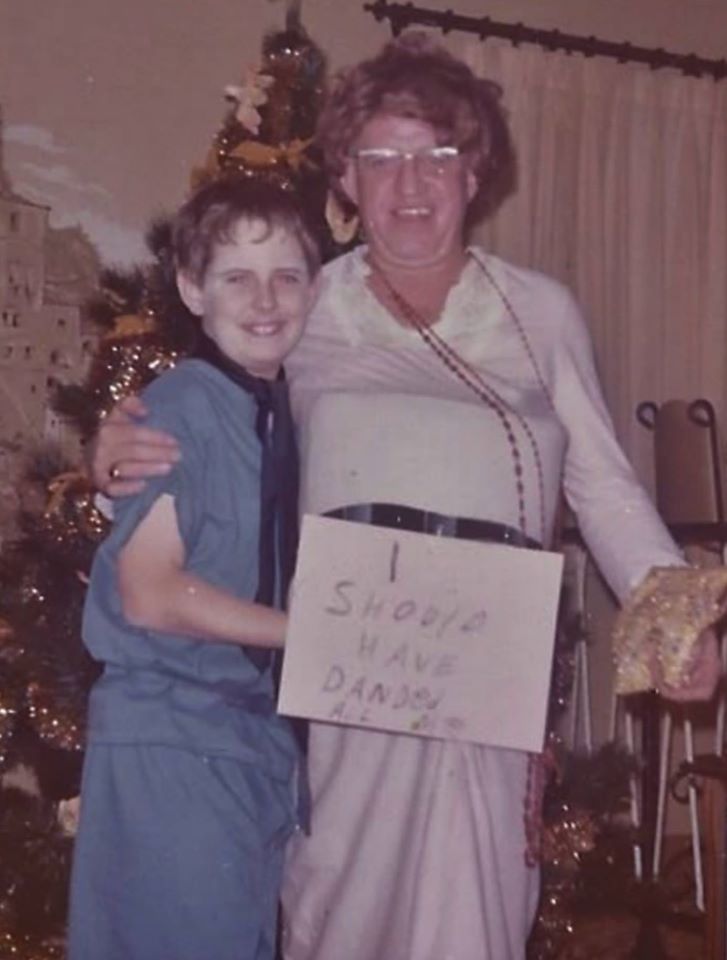
Often, the highlight of the evening turned out to be your appearance from the upstairs changing area. Invariably you’d come down as a woman, possibly decked out in one of Mom’s kaftan nightgowns, sporting rouge and a curly, auburn women’s wig that we had in storage. Perhaps you’d be a nervous beauty pageant contestant. One time you stuffed a cushion in the gown and pinned a sign on your distended, pregnant-looking belly that put a new lyrical twist to an old song, “I should have danced all night.”
I don’t think I’ve ever laughed as much or as loudly as I did on those nights in the sunken dining room. This was a golden era in our relationship.
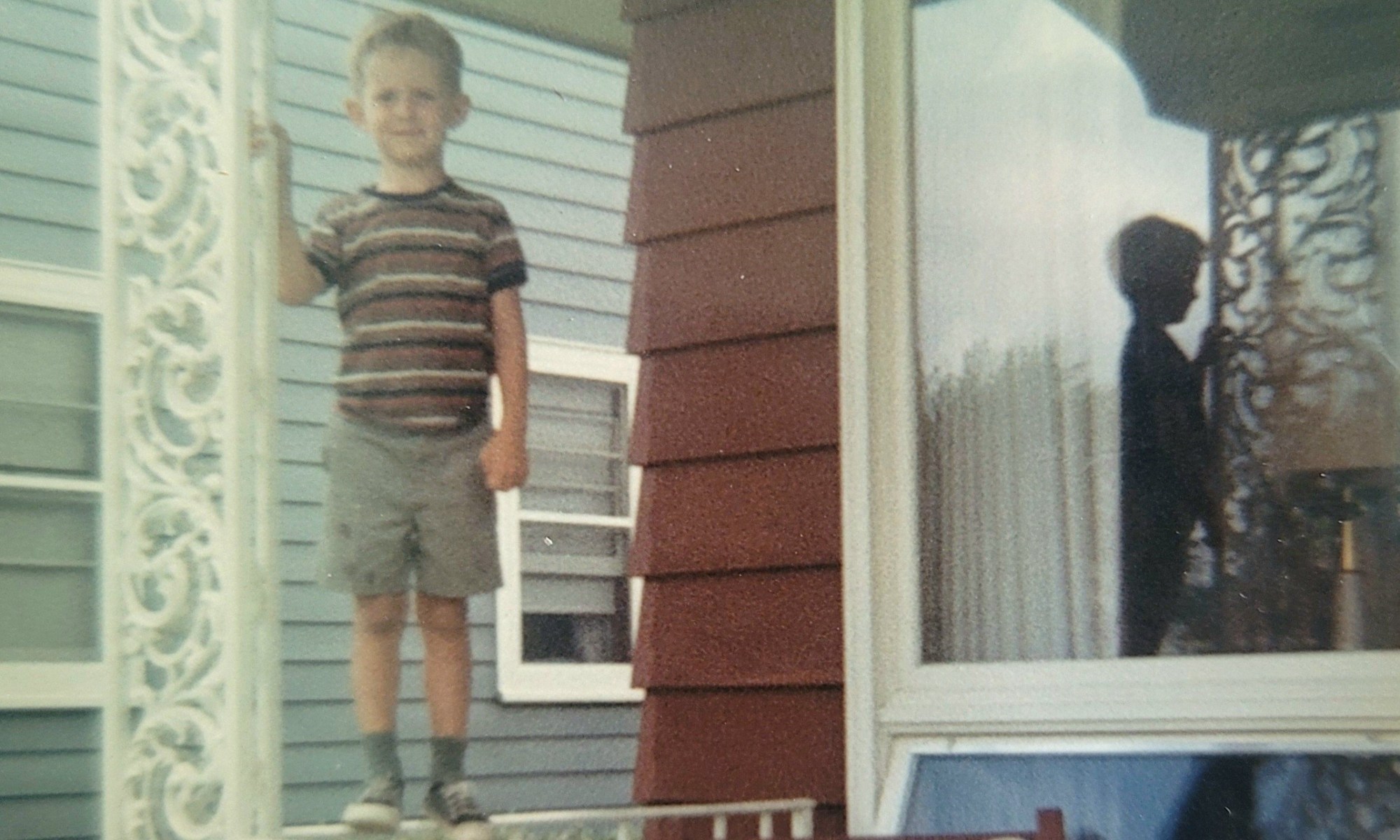
Another resonant space in the house on Hoeschler was the front porch, the place from where I’d set off on my first memorable adventure chasing fireflies around the side of the house. When I became old enough to climb, I’d mount the wrought-iron, filigreed railings and supports and pretend that they were ramparts in the epic battles I’d fight when left alone with a plastic sword and my own imagination.
That porch was also the place where you and I later sat on countless summer evenings, when I’d tell you of my recent adolescent adventures and let you in on some of my deep secrets: details about girls that I liked and those first romantic stirrings. Or maybe I’d share my dreams of becoming a professional football player—an aspiration which pleased you, I’m sure, though you’d always caution me over the near-impossible odds of that happening. As usual when I talked with you about things close to my heart, I would shake—a tremor that started deep in my chest and would radiate outward until it looked as if I were shivering from cold. Even in the heat of summer I’d shake like that. To this day, I don’t know why I did it, because I’ve never trembled when confiding to anyone else.
Later, during my high school years, I’d tell you about other experiences, like sexual encounters and even my pot use. Not coincidentally, this was also around the time that you started buying me condoms, which you always referred to as a man’s “vest pocket accessories.” In your mind, they were the latex barrier separating me from an unintended pregnancy, which, in your cut-to-the-chase way of putting things you called the “hundred-thousand-dollar mistake.” This practice continued into my early adulthood. Whenever I’d come back home for Sunday dinner, I could be assured I’d open my car door upon leaving to find that you’d tossed a box of Trojans onto the passenger seat. (How ironic that Dylan’s conception in early 1984 came about because I was too invested in the moment to run out to my car to grab a rubber.)
As for pot, you first found out about my use of it on a night during my tenth-grade year, when I stumbled in through the kitchen door late one winter night, drunk as a monkey, and you found a pipe in my coat pocket. Up until that time, both my drinking and my drug use had been secrets I’d concealed from you and Mom for nearly a year. As far as you knew then, I was still a promising school athlete. But in truth, by that time I had soured on the idea of organized sports and had set my sights on becoming a rock star and acting like one.
Incidentally, your having busted me drunk with a pot pipe was also the event that led you to start smoking cigarettes again after you had quit for two years and seven months. I know this period of abstention with precision because, for nearly three decades afterward, you would remind me and anyone within earshot that you’d once quit smoking “for two years and seven months.” That is (you’d always add), until that fateful night I came home drunk, and it stressed you out so much that you bought a pack of Pall Malls at the store and smoked them one after the other in your car.
Another thing the bust led to is something I now refer to with tongue in cheek as the “Great Agreement.” About a week after you found that pipe in my coat pocket and all hell broke loose in our world for a while, I sat down with you privately in the upstairs library room. We had a frank talk (with me trembling as usual) in which I expressed my desire to abstain from alcohol going forward. Even then my better angels sensed that drinking might cause me more trouble than good. However, I informed you that I was going to return to smoking weed. I conceded it wasn’t an ideal situation (it being illegal and all) but I remained firm that I was likely to do it again, and probably sooner than later. Strategically, I told you that I’d been thinking long and hard about the matter and decided I’d rather be upfront with you about it than try to do it behind your back.
To my amazement, you agreed that I be allowed to smoke pot. While not an ideal arrangement from your viewpoint as a parent, you seemed at least to conclude that it was a matter of looking reality square in the eye. You even admitted that, had it been available to you when you were my age, you’d have probably smoked it too.
Thus, the Great Agreement was struck. But like so many other grand proclamations uttered in our little nuclear family, especially those having to do with addictive substances, it wound up being a load of bull. Barely two weeks later, I was back to boozing it up on a regular basis, not only with friends, but now also at home with you and Mom. Your logic behind this abrupt change, really a rationalization, went something like this: If you couldn’t keep me from drinking outside the house, then you might as well let me do it at home too, where at least I might learn to drink responsibly.
None of us got the irony at the time. But really, how could we have? We were enmeshed in a complicity of sickness.
***
I moved back into the newly renovated house on Hoeschler Drive in March 2007, and right away I began having dreams of you and Mom. In them, there was always some conflict between us, some betrayal or outrage. A lot of times, one or both of you were drunk and that only inflamed the situation. Many of the dreams were set at the flower shop, where even in real life Mom and I battled often. Some took place in the house itself. I even remember one in which you and I were in a van. I was driving in that one, and for some reason I became so enraged that I let go of the wheel and reached across the front console to strangle you. I woke when my knuckles slammed into the nightstand beside my bed.
I often dreamed that you had somehow cheated your way out of death, like a character in a Monty Python scene. On so many nights, I dreamed that you had come out of that last bout of pneumonia and were back among us, and I’d just have to get used to the idea that you weren’t going anywhere any time soon. What’s more, the newfound and still unfamiliar personal power I’d felt in those early days of independence from you was now quashed. Fooled again. Defeated again. That was as close to a nightmare as my dreams got in those days.
I didn’t realize it then, but these were “moving through” dreams, necessary forms of mental preparation, motivation, and house cleaning. They were similar in purpose, though not in substance, to the dreams I had during the final year of my second marriage, in which I possessed the natural ability to float in the air and to fly around. It was so easy in those dreams, so satisfying an experience to soar above the trees and buildings! How did it happen, I’d muse, that I alone was so blessed with this ability? But then I would wake up, back into the real world of my troubled, obviously failing marriage. Only later did I learn that dreams of flying were a subconscious means of connecting with one’s own personal power—a power which, during that very codependent relationship, I had abdicated. On the very night after I moved out of that situation to live on my own in the south-side apartment, the flying dreams stopped, never to return.
The dreams I began to have after you died and I moved back into the old house were not so pleasant by comparison, but they were no less necessary. Those nocturnal battles offered opportunities I’d never had in real life to express the final word, to triumph over you in one form or another. During them, I was safe to express my resentment—and even my hatred—at you and at Mom without repercussion or threat of disownment, safe and free to tell you precisely what I thought, given license even to act out against you physically if necessary. You might have been gone in the corporeal sense, but my subconscious mind would summon you back night after night so I could bring you to account. I often woke exhausted during those first few years that I was back on Hoeschler Drive, and I carried the residual anger into the morning with me.
But I was working through unfinished business, necessary tasks, and eventually the fighting dreams lessened in frequency. And while I still have one occasionally these days, they are for the most part a thing of the past.
***
My initial plan for the house was another thing I ultimately left to the past. By sending the original pieces of furniture away for refinishing and repair, I was hoping to use them to recreate a visual space much like it had been in the early 1970s, when I was a boy going to Harry Spence Elementary. Earlier, I’d referred to this period as the “golden era” of our relationship, because that’s what it has become for me over so much of my adult life. But it wasn’t just nostalgia; there was no yearning for some mythical “good old days.” Instead, I concluded that something foundational between us was left behind there, something I don’t know that I can recapture. I could take a lazy way out and say it was simply a sense of innocence or naiveté on my part, but that really doesn’t approximate it.
Thing is, you were a different man then. You had not yet become the failing, bitter, alcoholic shell of a human being I turned away from in my thirties and forties. We laughed effortlessly in those days. You’d make up wonderful, hilarious stories at night. You invented a game you called “Easy Money,” in which you’d have me roll you across the living room floor while you dropped pocket change, then try to catch me as I’d scramble to pick up the quarters, nickels, and dimes littering the carpet behind me. When I was really young, you made up a tune, “The Moo Cow Song,” the lyrics of which you claimed to remember only on Sundays, and only when we were driving out to the rural town of Coon Valley to deliver funeral flowers.
This is not to suggest that you had no faults in the old days, because you did. I noticed them even then. There was that shift from playful to malevolent drunk that martinis brought on quicker than other cocktails. Or the harsh things you’d say to Mom during arguments, which she with her Irish-temper reciprocated tit for tat. (Admittedly I’m no angel in this respect, for I later became a mean-mouthed drunk myself, though rum was my poison.) There were the mysterious disappearances some evenings, and then your return much later, when I’d awake to your carryings on down in the kitchen or living room. Of course, there was also the morning you hit Mom when I was five. That was an absolute mark against you that no latter-day golden-age interpretation can ever erase.
And when actual imperfections seemed in short supply, I could always conjure up a few. Like the day we were driving to Milwaukee and I was in the backseat—just a little kid. I brought up a memory I’d had of a similar trip, and when neither you nor Mom recalled what I was talking about, I became so anxious I convinced myself that you’d been kidnapped and replaced by imposter parents. Then there was the time, some years later, when we were on a cruise of the Caribbean and came ashore in Puerto Rico for an afternoon of sightseeing. As the three of us strolled through downtown San Juan, you stepped away to visit a department store across a busy street. You returned about ten minutes later, empty handed and seemingly (to me anyway) evasive. My imagination took over right away and I scared myself into believing that you’d planted a bomb in that store.
Why did I do this? Maybe I needed to note these faults, both real and imagined, to tether you to me and my mortal existence, to keep you from floating off into the realm of gods. Because despite the imperfections in your character, these blemishes on the veneer of your person, you were nothing short of a hero to me. The evidence was overwhelming. For one thing, your toughness—that certain something I long equated with manliness—stood in sharp relief to my own childhood meekness, a characteristic so unfairly labeled by mid-twentieth-century American opinion as being that of a “sissy.” Later, as a young teenager, I cultivated an athletic persona, became more aggressive both physically and behaviorally, and, for a time, I basked in the light of your attention and pride. While it was no longer still the golden era of our time together, the early teens at least represented a soft landing from the former heights of childhood.
So, I guess it’s no surprise that my initial inclination was to replicate the place where so much of that childhood past played out. Just as I developed the adult ritual of parking near Harry Spence Elementary to reconnect with those times, I sought a similar reconnection in the childhood home I’d just inherited.
I don’t know what I’d hoped to accomplish by replicating that early-1970s interior. For one thing, I thought it might become a center of creativity like it was when I was a kid, and to some extent it did come close. I played music there again, practiced with bands in the basement just as I’d done as a teenager. I took up photography, did some blogging.
But the thing I really wanted to do, which was to continue writing, did not pan out as I’d hoped. The writerly zest and confidence I’d felt at my south-side apartment did not follow me to the old house. I would live back on Hoeschler Drive for almost nine years before marrying Katie in 2016 and moving across the river to Minnesota; and with only a few exceptions, my time there was a long and frustrating dry season. The writer’s group that had so flourished at the apartment met only a few more times at the house, then it fizzled out. I started some new fiction projects there, which ran out of steam. And I never did finish that novel.
I realize only now that I’d missed the real reason I was supposed to be back there. My first clue should have hit me like a slap in the face when the refinished tables arrived, and I discovered that they just didn’t fit the vibe of the house anymore. I’d had to throw away so many of the things that made our old house ours: the chairs and sofas that retained so much convivial energy from countless gatherings, the big cabinet-style TVs that played the shows that made us laugh, the original drapes and wall hangings, the table lamps, the dining room set, most of the wall hangings and art prints showing Grecian tableaus or scenes of old Europe. They were all damaged beyond repair from cigarette smoke and, in the later years of yours and Mom’s life, from neglect.
In their place, I’d had some of my photographs nicely framed and hung on the freshly painted walls. I bought abstract paintings from an art dealer who now rented the space in the old building by the university where your barbershop had been. The thick, cream-colored 1970s carpet that I removed was largely replaced by hardwood oak flooring. I had the original paneling in the front living room torn out and replaced with sheetrock.
Those French provincial tables back from the refinisher looked odd and far too small in this new interior. Of course, I couldn’t get rid of them. I just didn’t see a way to use them anymore. So, I stored them in the new garage. In their place, I opted for all mission-style furniture. I created a small conversation space in the living room with two new armchairs and a brown, patterned sofa that faced the larger picture window I’d had installed. I replaced the old circular dining table with a long, rectangular one that became the perfect spot for feeding friends and bandmates. The main TV, the only TV by choice, I put down in the lower-level family room, where I’d gotten rid of the old 1970s sectional and replaced it with a new couch and a big armchair that I thought resembled Captain Kirk’s on the bridge of the starship Enterprise.
I spent a good chunk of your life insurance money on this massive re-do of our old house, but it was sorely needed, and I don’t regret it one bit.
I think you and Mom would’ve liked what I did to the old place. But, really, it doesn’t matter one way or the other what you’d have thought, and that is kind of the point I’m getting at. In the end, rather than approximating some anachronistic redux of our former living environment, I made it my space, not ours. The new and, yes, improved house on Hoeschler Drive I cast in my image.
I did not think of it then, but in making these random alterations to the original design I was taking the first steps toward becoming my own man in the aftermath of your passing. And while the place that I returned to might not have hosted the burst of prolific, writerly creativity I’d assumed it would, it ended up serving an even higher purpose: It became the space where, through fitful dreams and consideration, I made better sense of my past.
But most importantly, I began to forge a new and welcome peace with you on equal terms.
 Rick Brown Writes
Another good read Rick. i was re-visiting the rooms of the house as I read along. Hard to picture it as it ended. Your Mom would never had allowed it to be like that in the “old days”. I just have to say I ma happy for you that you have some peace with life. I believe Katie had a lot to do with that part of course. Again, thanks for sharing !!
LikeLike